What is Homestuck?
Structurally ==>
Colloquially, Homestuck is referred to as a “webcomic,” however, it leans a lot further into the “web” side of things which makes it very different from your typical webtoon. Homestuck is told through a series of panels, where you click the link at the bottom to move to the next panel. Originally, Homestuck was an interactive “choose your own adventure” style internet comic that was popular on forums during the late 2000s [do correct me if I’m wrong, I was a little preoccupied being 1 year old in 2009 to be frequenting internet forums]. Andrew Hussie (the author of Homestuck) has a few other works in this style, where he would draw a panel, then users could submit requests for what they want the characters to do, then Hussie would draw the next panel using that, so on and so forth. That is how we get the unique style of Homestuck:
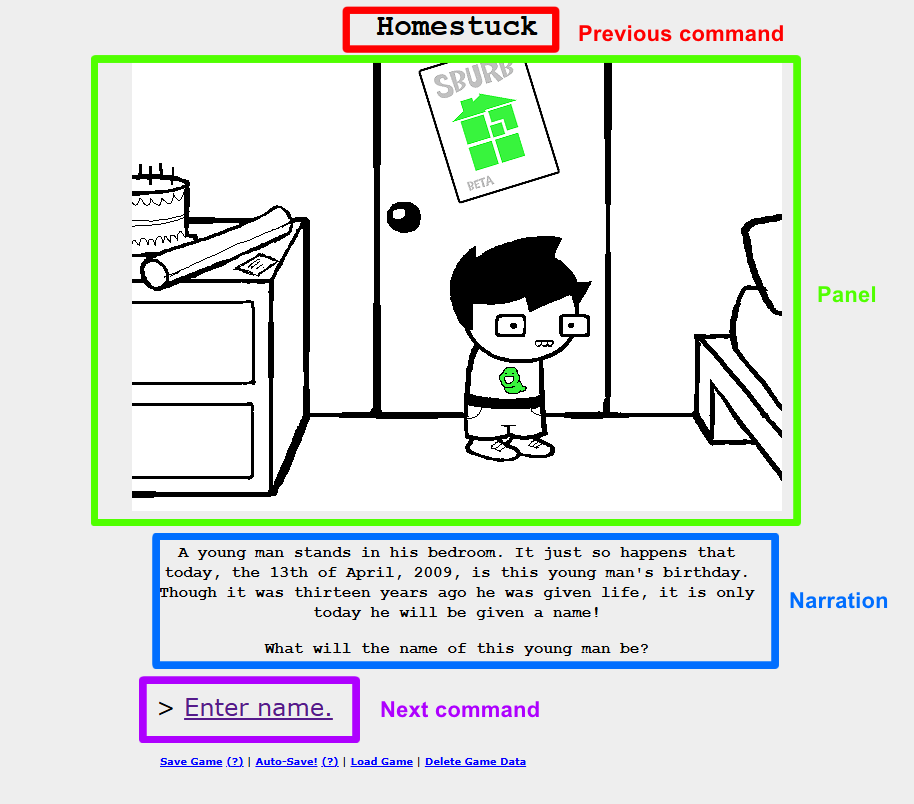
See my intro for an example!
This is why Homestuck is told in second person, because it is mimicking the style of a “choose your own adventure” story/video game! This exchange between the reader and the author continued until partway through Act 4, when Hussie closed the submission box for commands and continued the story on his own. However, he kept the same style, just writing his own commands. So from this point forward, it’s only echoing the look of an interactive story.
HOWEVER, the story was still very much interactive with its fans. Hussie would upload groups of panels together as he finished them, and most of the character names were suggestions from readers. Additionally, Homestuck includes videos, games, and interactive elements on some panels. For example, in this panel, when you press keys on your keyboard it makes Jade play different notes on her flute! Homestuck originally relied on flash for its interactive elements, so after the death of flash in 2020, the website was kinda sucky (the previously interactive elements became still frames or youtube videos, there were links that went to nowhere, etc.) BUT! Recently(ish) they have been revamping the website to bring the interactive elements and things back, which is pretty cool! There is also the Unofficial Homestuck Collection which has been around for a bit and preserves the original features of the comic.
Furthermore, another unique element of Homestuck is that all of the dialogue is told through chatlogs called pesterlogs. This is because, for a large portion of the comic, the characters are all in different locations and communicate via the internet. This allows for unique characterization through texting style (grammar, capitalization, spelling), color, and usernames! This is also where “typing quirks” come from.
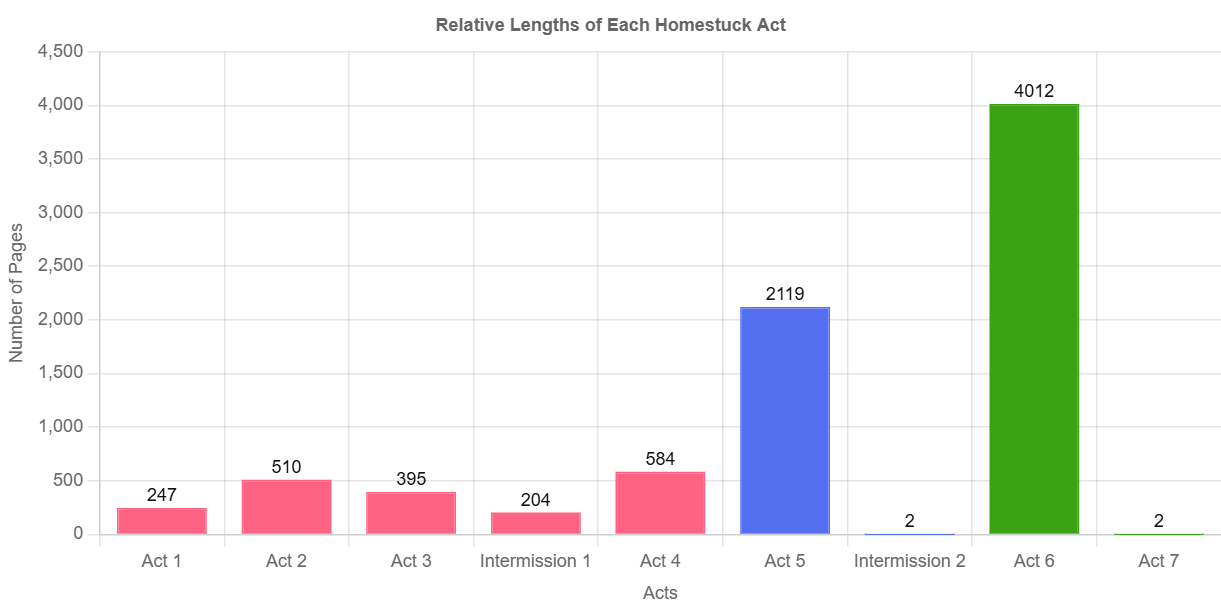
Additionally, Homestuck is organized into acts, rather than chapters or episodes, however these acts are NOT divided equally. Acts 1-4 are usually grouped together as they center around the four main “beta” kids and make up about 24% of the comic’s pages. Act 5 is split into two parts: Act 5 Act 1 and Act 5 Act 2. It introduces the trolls, and makes up about 26% of the pages. Act 6 is split into a bunch of Acts and Act Acts and Act Act Acts, so I won’t go into full detail but if you want more specifics you can find a whole bunch of analytics here. Act 6 makes up about 50% of the entire comic. Act 7 is just a series of images at the end, like an epilogue; it’s like 2 pages.Culturally ==>
Internet Reputation
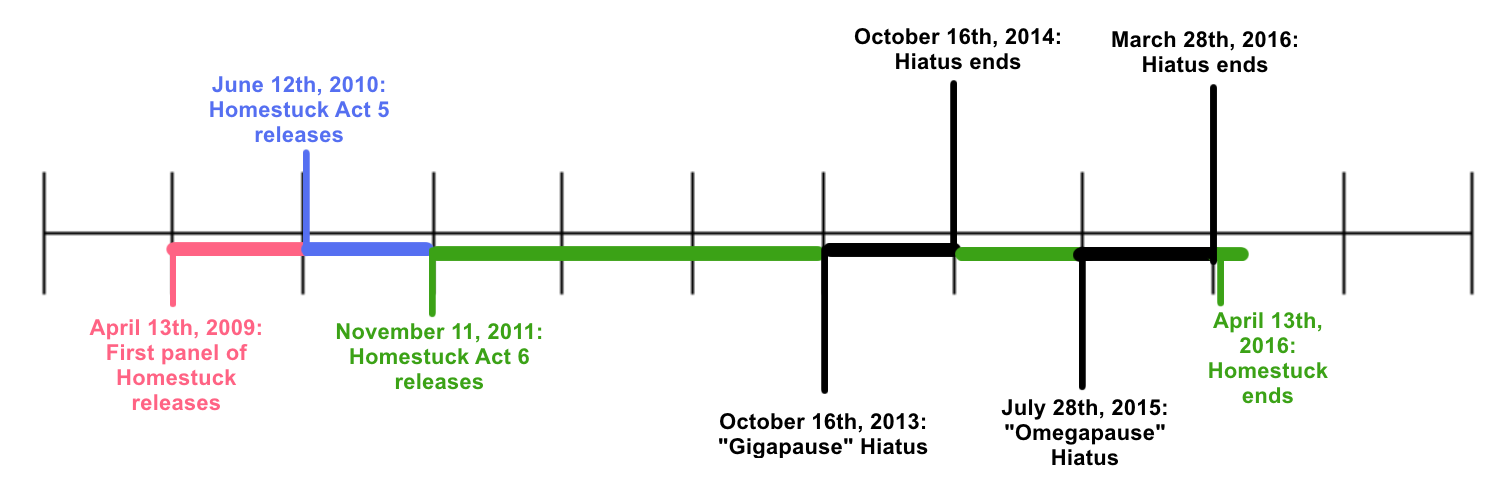
Homestuck is pretty infamous on the internet for having a large fandom of annoying, insensitive teens who make everything about Homestuck and don’t really know fandom etiquette, which, I won’t necessarily deny but I also don’t think is unique to the Homestuck fandom. [ALSO before I continue, disclaimer that I was not on the internet during the peak of Homestuck (2012-2016) due to being in elementary school, so I will try my best to give accurate information, but I am not a primary source]. Because Homestuck had such a large fandom, it was pretty well known on places like Tumblr. The comic spanned for 7 years, and was published in a series of updates. Therefore, whenever the comic was updated, people would post and make a pretty big deal about it, so it reached a lot of people.
I think the hatred for Homestuck fans boils down to a few factors: the age range of the fandom, the scale of the fandom, and the type of fans that it attracts. The main cast of Homestuck is between the ages of 13-16, so it makes sense that a majority of fans are younger. Teenagers are not exactly known for their admirable fandom etiquette, but again, I don’t think this is at all unique to Homestuck. However, Homestuck itself is incredibly large (as in, the amount of pages/words, but also the extent of what it covers in terms of characters, arcs, themes, references, humor, etc.) which attracts a very diverse audience and also allows pretty much anything to be connected back to Homestuck in some way. Moreover, Homestuck as a work is very curated to people who use the internet more than the average person as seen in its references, character archetypes, and of course the structure of the actual comic. I think this kind of audience (young internet users) at such a large scale is what drives a lot of the negative attention.
Additionally, one of the biggest reasons Homestuck fans were hated back in the day is because of their behavior at cons. In Homestuck, a large portion of the characters are aliens called “trolls,” which have grey skin. Naturally, you can imagine our young audience going to a con, maybe even for the first time, and wanting to cosplay their favorite Homestuck troll, so they decide to cover themselves in grey face paint. Unfortunately, if you aren’t experienced in cosplay, you may not know that you need to seal your face/body paint before you go out and touch stuff, otherwise it will get on everything. While one fan with unsealed facepaint might not be a huge issue, when you’ve got hundreds of teens coloring themselves in grey and running around at cons not realizing they need to seal it, that creates a pretty bad reputation.
Moreover, there is the infamous “Sharpie Bath Incident,” in which a fan who was cosplaying a Homestuck troll decided to dye their skin grey by putting sharpie ink into the bathtub of the hotel they were staying at, and bathing in the water. Obviously, this damages the bathtub and it can also give you alcohol poisoning, so it was pretty bad!!Vriska
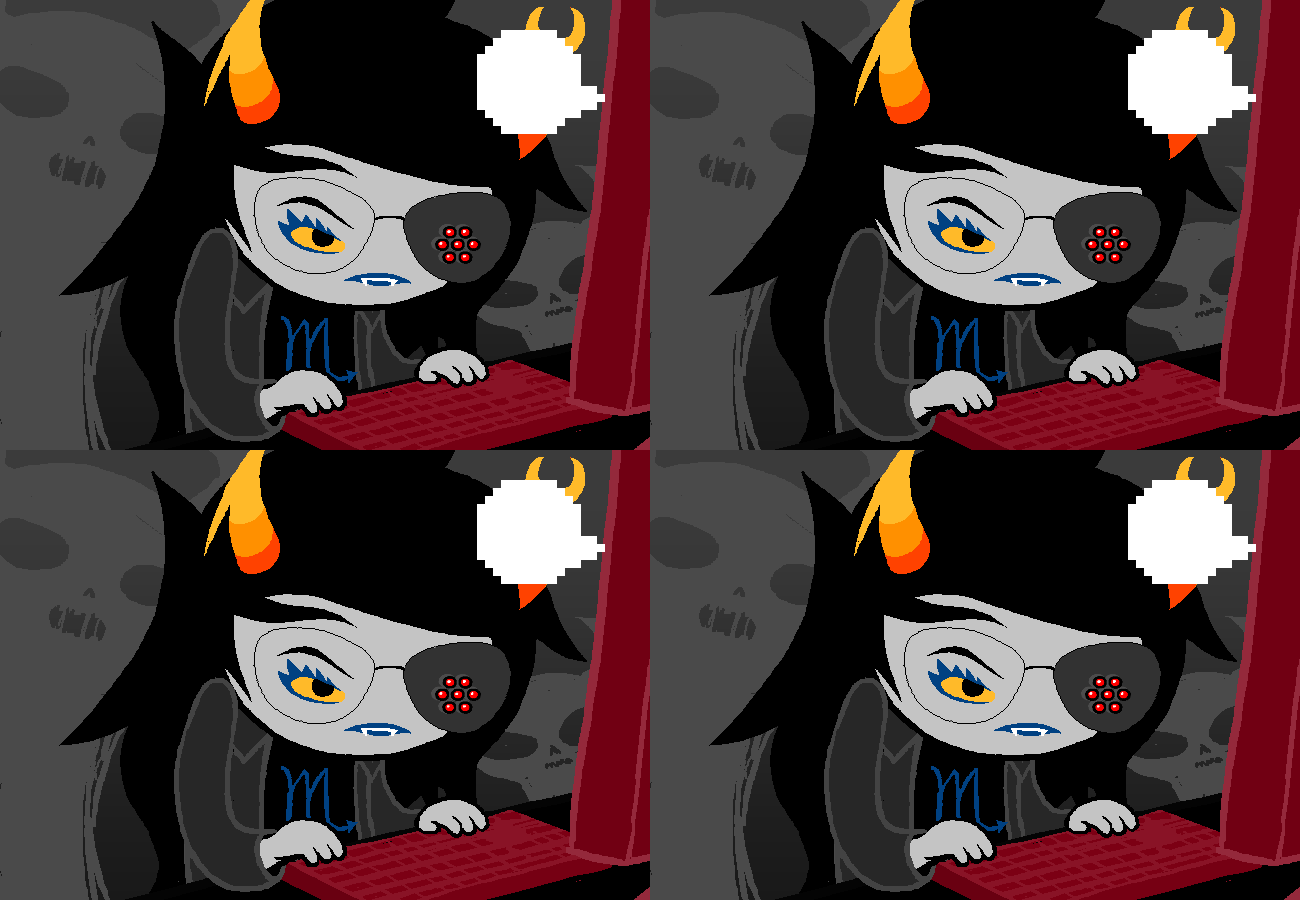
Vriska is arguably one of the most well known Homestuck characters on the internet. She’s one of the main trolls, and she sparks a lot of controversy on the internet for being a character that is both incredibly mean and horrible to other characters (incidents include paralyzing a kid and then making fun of him for being disabled, blinding her best friend as revenge, etc.), while also leading the story and driving many of the main plot points. I also think she is a really interesting and complex character. Since the internet is not exactly praised for its attentiveness to nuance, there are a lot of people who absolutely hate her and a lot of people who really like her and that can create a lot of hostile tension.Typing Quirks
Additionally, Homestuck is so incredibly popular that its impact on fandom is pretty widespread. For example, in Homestuck all of the trolls have what’s called a “typing quirk” which is essentially 4 CH4NG3 TH4T Y0U M4K3 t0 the way y0u type cERTAIN wORDS, lETTERS, or phr8ses in order to fit fin wwith a :33< purrtain theme or JUST STAND OUT. [a change that you make to the way you type certain words, letters, or phrases in order to fit in with a certain theme or just stand out.] In 2020, typing quirks gained a lot of popularity as a way to spice up your internet persona. People still use typing quirks today, and I don’t think a lot of them even know that they originate from Homestuck.Queerness
Moreover, although I wasn’t there at the time to really understand the impact, I do feel like it's important to mention that Homestuck as a whole is very openly queer. The trolls as a species consider bisexuality the default, and are either confused by or call out the human characters’ homophobia. Moreover, the queer characters and relationships in the comic are not treated as side plots to heterosexual relationships, but are central to the story. There are queer characters who are very secure in their identity, and queer characters who are figuring out their identity, and even a canonical genderqueer character. I feel that overall Homestuck is very refreshing in its queer representation that feels authentic rather than curated. Considering the majority of the comic was published before gay marriage was even legalized in the entire United States, I think Homestuck’s inclusion of queer characters in this way is pretty significant.Conclusion
Overall, Homestuck’s origins as an interactive conversation between reader and author combined with the fact that it was just written by some guy who was passionate about what he was doing separates it from a lot of other mainstream media. Because it was an amateur project and not something done through a company or to make money, it feels a lot more creatively raw; it’s unpolished but authentic. While Homestuck has definitely shaped fandom culture, I think fandom itself has shaped the comic in a lot of ways that aren’t really the same for other pieces of media (besides, maybe, the DSMP). Culturally, I think that Homestuck’s heavy use of pop culture references, along with the influence its fandom has had on the comic itself, allows it to function as a kind of time capsule of the era in which it was created.
Reference Information